Optical spectra of plasmonic Au clusters and nanoparticles obtained using the TDDFT+U method
Mohit Chaudhary, Jean Lermé & Hans-Christian Weissker
Nanoscale, 2026,18, 5389-5399
https://doi.org/10.1039/D5NR04178C
Many of the applications of metal clusters and nanoparticles make use of the localized surface-plasmon resonances. To use the full potential of these systems, their properties need to be understood precisely ; accurate, predictive calculations are necessary, which today are mostly attempted using Time-Dependent Density-Functional Theory (TDDFT). In the noble metals, the presence of the filled shell of d electrons complicates these calculations, because these electrons are notoriously badly described in the customary “simple” approximations of TDDFT.
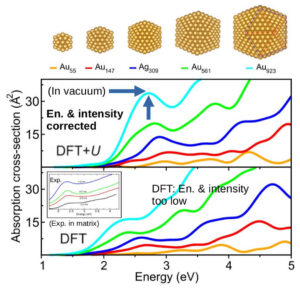
Recently, we have shown that a Hubbard U correction within the TDDFT+U method obtains precise spectra of a large size range of silver clusters, with a surprisingly transferable U parameter [Nat Commun 15, 9225 (2024)]. In the present work, we show that the TDDFT+U approach yields likewise good surface-plasmon energies for plasmonic gold clusters, i.e., clusters larger than 150…300 atoms. (For smaller, non-plasmonic clusters, the correction proves insufficient.) The computational cost of the TDDFT+U approach is only slightly higher than for “normal” TDDFT calculations, allowing us to calculate spectra for clusters of up to 923 atoms (a nanoparticle of 3 nm).
Our work will open the pathway for precise, predictive calculations of systems of practical relevance, including the coupling of gold clusters between each other or with bio-molecules.